Strategy, Experience, Technology
Why Are We So Lonely? Causes of Modern Loneliness
Modern loneliness is not primarily a screen-time problem. It grows when opportunities to meet shrink, relationships fail to provide reciprocity, and people expect connection to go worse than it often does.
Mert Barbaros ·
A lonely evening can contain hundreds of notifications. That is not a contradiction. Notifications measure activity. Loneliness measures the gap between the connection a person needs and the connection they feel they have.
The phone is an easy suspect because it is visible. It is on the table, in the hand, glowing in the dark. The forces that make connection harder are less visible: fewer shared places, more life conducted at home, economic pressure, fragile social networks, neglected friendships, poor health, fear of rejection, and the simple difficulty of asking another person to stay in a conversation.
The evidence does not support a clean story in which smartphones created modern loneliness. The World Health Organization's global review says something: we do not have enough consistent historical data to prove that humanity is becoming steadily lonelier everywhere, and many popular explanations remain unproven.
What the evidence does show is serious enough. Loneliness is widespread, in-person contact has declined in several populations, daily life has moved inward, and the opportunities and skills required for connection are unevenly distributed.
My conclusion is that loneliness is an architecture problem before it is a screen-time problem. It becomes more likely when one or more parts of social life fail: people have too few natural opportunities to meet, the relationships they do have lack sufficient quality or reciprocity, or fear and pessimistic expectations make the next attempt feel harder than it really is. Digital technology can worsen these failures. It can also help repair them.
Loneliness Is Not the Same as Being Alone
The language matters because three different experiences are routinely collapsed into one.
Social isolation is an objective shortage of relationships, roles, or interaction. Loneliness is subjective: the painful difference between the connection someone wants and the connection they experience. Solitude is time alone that may be chosen, restorative, creative, or necessary.
A person can live alone and feel deeply connected. Another can share a home, attend meetings all day, exchange messages constantly, and still feel emotionally abandoned. Contact is not the same as support. Proximity is not the same as being known.
This is also why the phrase “loneliness epidemic” needs care. The public-health burden is real. WHO estimates that about 16% of people globally experienced loneliness across the evidence reviewed from 2014 to 2023. The burden was not concentrated among older adults. Estimated prevalence was highest among adolescents and young adults, and higher in lower-income countries.
The U.S. Surgeon General's advisory reaches the same policy conclusion from a national evidence review: social connection is shaped by community infrastructure, public policy, health systems, workplaces, cultural norms, and digital environments. It is not merely the result of individual discipline.
But a high prevalence today does not prove one uninterrupted global rise caused by one modern habit. Historical trends differ by country, age, period, and measurement. The pandemic increased loneliness in many groups, but it entered a social world that was already changing.
The better question is not “What single thing made everyone lonely?” It is “What now makes satisfying connection difficult to begin, maintain, and trust?”
We Have Fewer Places to Meet Without Planning It
One of the quietest changes in social life is that more of it now happens at home.
American time-use data show that the share of free time spent alone rose from 43.5% in 2003 to 48.7% in 2019, before reaching 50.7% in 2020. Free time spent with people outside the household fell over the same period. Time with friends declined particularly sharply. The analysis found no evidence that the pre-pandemic rise in time alone was simply explained by people replacing in-person socializing with email, phone calls, computer use, or online games.
Americans were spending more free time alone before the pandemic
COVID-19 intensified an existing shift in social time rather than creating it from nothing.
The share of U.S. free time spent alone increased from 43.5% in 2003 to 48.7% in 2019 and 50.7% in 2020. Free time spent with people outside the household fell from 21.9% to 17.3% and then 12.3% over the same years.
| Year | Free time alone | Free time with non-household people |
|---|---|---|
| 2003 | 43.5 | 21.9 |
| 2019 | 48.7 | 17.3 |
| 2020 | 50.7 | 12.3 |
A second analysis found that U.S. adults spent one hour and 39 minutes more at home per day in 2022 than in 2003. Work explains only part of the movement. Shopping, entertainment, eating, worship, education, and leisure also shifted inward.
Home can be safe, intimate, productive, and necessary. The problem is not the front door. The problem is what disappears when daily life no longer passes through many shared spaces.
A commute contains familiar strangers. A library, park, café, playground, place of worship, neighborhood shop, or community center can turn repeated proximity into recognition. These small contacts are not automatically friendships, but they create the raw material from which trust and belonging can grow. When every interaction requires a calendar invitation, a journey, disposable income, and enough emotional energy to organize it, connection becomes expensive.
The OECD's 2025 report calls the places and services that make interaction possible social infrastructure. This includes parks, libraries, sidewalks, transport, schools, community organizations, cafés, and other accessible places where people can encounter one another without building the entire occasion from scratch.
Housing, income, health, work schedules, transport, safety, disability, discrimination, and neighborhood design affect access to that infrastructure. Someone working multiple jobs does not have the same social calendar as someone with protected leisure. Someone who cannot reach a public space does not have the same opportunity to “just meet people.” Someone priced far away from friends and family is not suffering from a defective attitude.
The broader political-economic account of modern loneliness makes the same corrective point. Institutions, markets, cities, and working conditions shape the time and places available for connection. Personal habits matter inside those conditions, not outside them.
Connection becomes fragile when every human encounter requires unusual effort.
This is the first failure in the architecture of connection: the supply of ordinary encounters shrinks. Telling people to put down their phones does not reopen a library, shorten a workday, make housing affordable, repair public transport, or place trusted people within walking distance.
More Contact Does Not Guarantee More Connection
Even when interaction is available, its quantity can mislead us.
Across OECD countries, frequent contact, loneliness, and perceived relationship quality are only weakly correlated. A person may speak with others every day and still lack someone dependable in a crisis. Another may have fewer interactions but experience them as secure, generous, and sufficient.
What matters is not only who is present, but what the relationship can carry.
A useful relationship offers some combination of care, mutual attention, practical help, trust, belonging, intimacy, challenge, and the freedom to be imperfect. Not every relationship needs to provide every function. In fact, expecting one romantic partner to become lover, closest friend, therapist, co-parent, financial partner, social organizer, and sole witness to an entire life can make a social network more fragile.
Research and narratives about consequential friendship show how much adult care sits outside conventional romantic categories: shared homes, caregiving, grief, money, parenting, major decisions, and long-term commitment. These relationships are often socially invisible because our language treats friendship as important but secondary.
The answer is not to replace romance with friendship or to collect as many contacts as possible. It is to build a distributed social life in which different relationships can carry different forms of support. A partner may provide intimacy. A friend may provide history and honesty. A sibling may provide continuity. A neighbor may provide practical help. A group may provide identity and shared purpose.
This is the second failure: contact exists, but reciprocity is weak or concentrated in too few places.
Reciprocity does not mean that every interaction is perfectly balanced. It means the relationship can answer back. Attention is returned. Disclosure is met with care. Help can move in both directions over time. The person does not feel like they are broadcasting their life into a silent system.
Loneliness Can Teach the Brain to Expect Rejection
The third failure happens inside the person, but that does not make it a personal fault.
Loneliness behaves like a signal. Hunger pushes attention toward food. Perceived social isolation pushes attention toward possible social threat. That response can be protective in a genuinely hostile environment, but when it persists, it can make neutral situations look less welcoming and uncertain interactions feel more dangerous.
The scientific account developed by John Cacioppo and William Patrick describes a self-reinforcing pattern. A person feels disconnected, becomes more alert to rejection, interprets ambiguity defensively, withdraws or behaves cautiously, receives fewer warm responses, and takes that result as evidence that other people were unsafe all along.
The loop is painfully efficient:
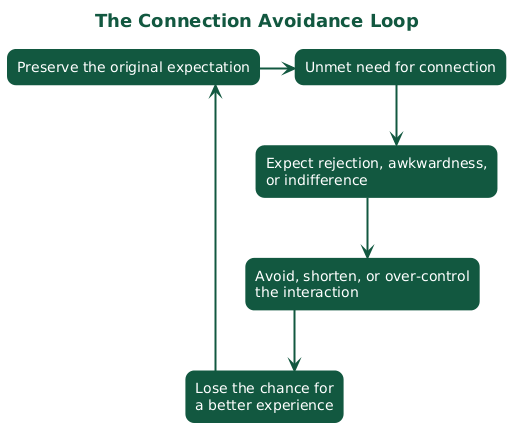
This does not mean loneliness is imaginary. It means the condition can make its own remedy harder to approach.
The surrounding culture adds friction. We accept isolating norms because everyone else appears busy. We wait for spontaneous chemistry instead of making a specific invitation. We assume people already have enough friends. We treat connection as something that should happen naturally, then feel ashamed when it requires deliberate work.
The social-psychology research synthesized by Natalie Kerr and Jaime Kurtz repeatedly returns to this forecasting problem. People often underestimate how willing others are to talk, how much a small expression of warmth matters, and how ordinary repeated contact can become friendship. Structural opportunity and personal expectation work together. A welcoming café cannot help someone who never enters, but courage alone cannot compensate for a city with nowhere affordable to go.
The Phone Is Not the Origin Story
Digital technology arrived inside this already complicated system. It did not create the human need for belonging, unequal access to social life, insecure attachment, bereavement, exclusion, poor health, or fear of rejection.
The broad research on social media and loneliness is mixed because “phone use” is not one behavior. A meta-analysis covering 48,383 participants found only a tiny overall association between social-networking-site use and loneliness. Passive and abnormal use were associated with more loneliness, while general and active use were not significant. A 2025 scientific review argues that the more useful unit of analysis is the interaction: who used the platform, why, with whom, how the other person responded, and what the activity displaced.
Longitudinal evidence suggests loneliness and problematic media use can reinforce each other, but the effects become small when prior differences are properly controlled. This is a feedback loop around problematic behavior, not proof that ordinary app use makes people lonely.
Digital contact can also preserve relationships. A four-wave study of adults aged 55 to 98 found a small later reduction in loneliness associated with social internet use. The number of frequently contacted people did not explain the result, suggesting that perceived availability or relationship maintenance may matter more than simply adding names to a network. During pandemic restrictions, face-to-face contact was more strongly associated with mental health, yet text communication still mattered. “Digital” and “real” are not opposites. A real person can be reached digitally.
The clearest evidence of harm is narrower. When a phone competes with someone already present, it can divide the attention through which conversation becomes rewarding. In a field experiment with 304 diners, people assigned to keep phones available used them more, felt more distracted, and reported less interest and enjoyment than people assigned to put them away.
Research on phubbing, the word was coined in May 2012 by the Australian advertising agency McCann Melbourne, which means ignoring someone in favor of a phone, points to the same mechanism. A 52-study meta-analysis linked partner phubbing with lower satisfaction, intimacy, and responsiveness, together with more conflict and jealousy. Most included studies were cross-sectional, so the direction can run both ways. Phone neglect can strain a relationship, and a strained relationship can make the phone more attractive.
A qualitative review of phubbing shows why context decides what the device means. Opening a private feed during someone's unfinished sentence is not socially equivalent to calling a distant parent, translating a question for the group, sharing a photograph, or arranging the next meeting. Purpose, timing, relationship norms, content, and communication shape whether the phone feels useful or rejecting.
The same phone can add connection or subtract it
Digital activity is most likely to support connection when it enables otherwise difficult contact or creates one shared focus. It is most likely to weaken connection when it privately interrupts a person who is already present or replaces a richer interaction without producing reciprocity.
| Digital behavior | What it does socially | Likely role |
|---|---|---|
| Calling someone who cannot be present | Makes otherwise unavailable contact possible | Adds connection |
| Messaging to arrange a meeting | Converts digital coordination into shared time | Supports connection |
| Using a shared question, map, photograph, or translation | Gives people one common object of attention | Organizes connection |
| Opening a private feed during a conversation | Moves attention away from someone already present | Interrupts connection |
| Compulsive checking after feeling rejected | Offers immediate activity without guaranteed care | May reinforce the loneliness loop |
| Public posting without meaningful response | Produces visibility but not necessarily reciprocity | Creates ambiguous social value |
Screen time counts the minutes and discards the mechanism. The more useful questions are: What did this interaction replace? Did it divide or organize attention? Did another person respond? Did the relationship continue after the interface closed?
We Often Misjudge Conversation Before It Starts
If loneliness partly persists because connection feels risky, the beginning of a conversation matters more than it appears.
People make two opposite forecasting errors. We expect an ordinary subject to be boring. We expect a personal subject to be awkward. Both predictions give too little credit to what another person contributes once the conversation begins.
Nine preregistered experiments with 1,800 participants found that people consistently underestimated how interesting and enjoyable conversations about supposedly boring topics would become. The pattern appeared with friends and strangers, online and in person, and with assigned or self-generated topics.
One experiment explains why. People who participated in a live conversation underestimated its value. People who merely read the transcript or watched a recording of the same conversational content did not show the same error. The subject was static and easy to judge in advance. The engaging part was dynamic: listening, responding, adapting, remembering, disagreeing, and making meaning together.
At the other end of the spectrum, a multi-experiment program on deeper conversation found that people expected personal exchanges to feel more awkward and less caring than they later experienced. Participants generally felt more connected and happier afterward than they had predicted. The forecasting error was smaller with close partners, whose interest was already easier to trust.
Neither finding means every conversation should become a confession. A question can be deep and completely wrong for the relationship, culture, power dynamic, or moment. Consent, trust, and the right to skip matter. Emotional intensity is not a quality score.
The research suggests three useful modes instead of one ladder:
- Ordinary conversation builds familiarity. A small subject gives people somewhere easy to begin.
- Playful conversation creates energy and lowers pressure. This is a design inference rather than a separately proven treatment in these studies.
- Deeper self-disclosure can create closeness when the relationship has enough safety to hold it.
A good conversation can move through all three. What makes it meaningful is not the apparent brilliance of the prompt. It is the response that follows.
We overestimate the importance of the topic and underestimate the intelligence of the interaction.
No study reviewed here proves that ordinary, playful, or deep questions make people check their phones less. That would require a direct experiment comparing prompt types and measuring later device behavior. The evidence supports a narrower and more useful conclusion: live, responsive conversation is more engaging than people predict, while competing phone use can make an existing interaction less enjoyable.
A Conversation Product Should Solve a Small, Honest Problem
No app can repair housing, transport, work schedules, public space, family history, grief, discrimination, or mental illness. It cannot manufacture friendship. It should not promise to cure loneliness.
It can still solve a real problem: the awkward minutes and phubbing.
With reversing phubbing.
A blank conversation asks someone to invent a topic, judge the relationship, estimate the other person's interest, choose an acceptable level of vulnerability, risk rejection, and begin. That is a surprising amount of social work before either person has said anything meaningful.
A well-designed prompt can carry part of that burden. But a question needs a social container: a clear reason for being together, boundaries, permission to decline, shared attention, and an ending. Without those conditions, a “deep question” can feel less like connection and more like extraction.
That thinking shaped Let's Talk, the synchronized conversation card app we built with Murat Dural and Elif Akay Erdem for partners, friends, families, and groups. Everyone receives the same question at the same time. Each person can read it in a preferred language. The group moves together rather than disappearing into separate feeds.
The product is not trying to become the most interesting person at the table. Its job is smaller:
- Make beginning easier.
- Give everyone the same object of attention.
- Offer enough range to move from ordinary to playful or personal conversation without forcing depth.
- Let the screen become secondary once people start responding to one another.
That is the boundary we want to keep. A social product should not measure success only by how long it can retain attention. Sometimes the healthiest interface is the one that introduces a worthwhile question and then loses the room to the people inside it.
Explore Let's Talk when you want a better place to begin. The app can provide the question. The people in the room still create the connection.
Sources
World Health Organization Commission on Social Connection. "From Loneliness to Social Connection: Charting a Path to Healthier Societies" World Health Organization, 2025. View source
Office of the U.S. Surgeon General. "Our Epidemic of Loneliness and Isolation" U.S. Department of Health and Human Services, 2023. View source
OECD. "Social Connections and Loneliness in OECD Countries" OECD Publishing, 2025. View source
Atalay, E.. "A Twenty-First Century of Solitude? Time Alone and Together in the United States" Federal Reserve Bank of Philadelphia Working Paper 22-11, 2022. View source
Sharkey, P.. "Homebound: The Long-Term Rise in Time Spent at Home Among U.S. Adults" Sociological Science, Vol. 11, 2024. View source
Dwyer, R. J., Kushlev, K., & Dunn, E. W.. "Smartphone Use Undermines Enjoyment of Face-to-Face Social Interactions" Journal of Experimental Social Psychology, Vol. 78, 2018. View source
Deschamps, A., Fortier, M.-E., Munoz Gomez, N., Auger, A.-M., Fitzpatrick, C., & Brodeur, M.. "Understanding Phubbing Behavior: A Scoping Review of Qualitative and Mixed-Methods Studies" Computers in Human Behavior Reports, Vol. 18, 2025. View source
Ni, N., Ahrari, S., Zaremohzzabieh, Z., Zarean, M., & Roslan, S.. "A Meta-Analytic Study of Partner Phubbing and Its Antecedents and Consequences" Frontiers in Psychology, Vol. 16, 2025. View source
Fam, J. Y., & Mannikko, N.. "Loneliness and Problematic Media Use: Meta-Analysis of Longitudinal Studies" Journal of Medical Internet Research, 2025. View source
Stieger, S., Lewetz, D., & Willinger, D.. "Face-to-Face More Important Than Digital Communication for Mental Health During the Pandemic" Scientific Reports, Vol. 13, 2023. View source
Janssen, J. H. M., van Tilburg, T. G., van Ingen, E., Corten, R., Peeters, G., & Olde Rikkert, M. G. M.. "The Relationships Between Social Internet Use, Social Contact, and Loneliness in Older Adults" Scientific Reports, Vol. 15, 2025. View source
Hall, J. A.. "Loneliness and Social Media" Annals of the New York Academy of Sciences, Vol. 1543, Issue 1, 2025. View source
Zhang, L., Li, C., Zhou, T., Li, Q., & Gu, C.. "Social Networking Site Use and Loneliness: A Meta-Analysis" The Journal of Psychology, 2022. View source
Cacioppo, J. T., & Patrick, W.. "Loneliness: Human Nature and the Need for Social Connection" W. W. Norton, 2008. View source
Hertz, N.. "The Lonely Century: How to Restore Human Connection in a World That's Pulling Apart" Currency, 2021. View source
Cohen, R.. "The Other Significant Others: Reimagining Life with Friendship at the Center" St. Martin's Press, 2024. View source
Kerr, N., & Kurtz, J.. "Our New Social Life: Science-Backed Strategies for Creating Meaningful Connection" Oxford University Press, 2025. View source
Parker, P.. "The Art of Gathering: How We Meet and Why It Matters" Riverhead Books, 2018. View source
Kardas, M., Kumar, A., & Epley, N.. "Overly Shallow? Miscalibrated Expectations Create a Barrier to Deeper Conversation" Journal of Personality and Social Psychology, 2021. View source
Trinh, E. N., Thio, N., & Klein, N.. "Conversations About Boring Topics Are More Interesting Than We Think" Journal of Personality and Social Psychology, 2026. View source