Strategy, Experience, Technology
Self-Regulation Is Not Willpower
Self-regulation is not a contest between willpower and temptation. It is a system for choosing goals, preparing action, shaping the environment, reading feedback, regulating emotion, and changing course when reality changes.
Mert Barbaros ·
Most self-improvement products begin with a quiet accusation. You set a goal, miss a few days, watch the streak turn gray, and conclude that you lacked discipline.
It is a clean story. It is also a poor model of human behavior.
Self-regulation is the process of keeping thoughts, emotions, attention, motivation, and behavior aligned with a goal while circumstances change. Self-control is only one part of it: inhibiting an impulse, initiating an intended action, or sustaining effort when another response competes. Lasting behavior change also depends on choosing the right goal, preparing for predictable situations, shaping the environment, monitoring useful feedback, regulating emotion, recovering after failure, and sometimes abandoning a goal that no longer makes sense.
My conclusion is simple: self-regulation is not a reservoir of willpower. It is an adaptive system. When that system is weak, asking for more discipline usually adds pressure without fixing the failure. When the system is well designed, less discipline is required because fewer decisions are left for the worst possible moment.
Willpower Is Too Small for the Job
Imagine someone wants to exercise after work. At 8:00 in the morning, the goal feels obvious. At 7:00 in the evening, the person is tired, hungry, answering messages, and standing three meters from a sofa that has never once demanded a warm-up.
Calling the outcome a test of character hides the machinery.
The person may not have chosen a specific time. Their clothes may be in another room. The planned workout may be too difficult for a low-energy evening. Dinner may be late. The goal may come from guilt rather than personal value. There may be no recovery plan for a missed day. Every missing decision is transferred to the moment when attention and energy are already under pressure.
Self-control matters in that moment, but it has been asked to rescue a system that did not prepare.
The distinction matters because self-control is narrower than self-regulation:
- Self-control initiates an intended action, inhibits a competing response, or sustains effort.
- Self-regulation chooses the goal, prepares the action, manages the context, interprets feedback, and changes course.
The 2016 Handbook of Self-Regulation reviews the familiar idea that self-control behaves like a limited resource, but it also documents the problems with treating willpower as a literal fuel tank. Performance after effort can change with motivation, attention, priorities, beliefs, task meaning, stress, and competing rewards. Fatigue is real. A single depleted-resource story is not enough to explain it.
This is not an argument that discipline is imaginary. It is an argument that discipline should not be forced to do the work of planning, environment design, motivation, recovery, and judgment at the same time.
People with better self-control do not necessarily spend every evening winning a civil war against themselves. They often experience fewer conflicts because useful behavior has become habitual, the cue is stable, and the environment is not repeatedly inviting the opposite action. The best time to regulate a temptation may be hours before it appears.
The body also gets a vote. Sleep loss can weaken attention, increase emotional reactivity, and make immediate rewards harder to ignore. Stress, illness, hunger, cognitive overload, and the demands created by other people can change the same person's behavior from one day to the next. A missed action may reveal a broken plan, but it may also reveal that the system is asking for performance from a body and a life that have no room left.
A good self-regulation system makes the desired action easier to begin, easier to evaluate, and easier to resume. It does not merely demand stronger resistance.
Self-Regulation Is a Feedback Loop
The research becomes much clearer when self-regulation is treated as a loop rather than a personality trait.
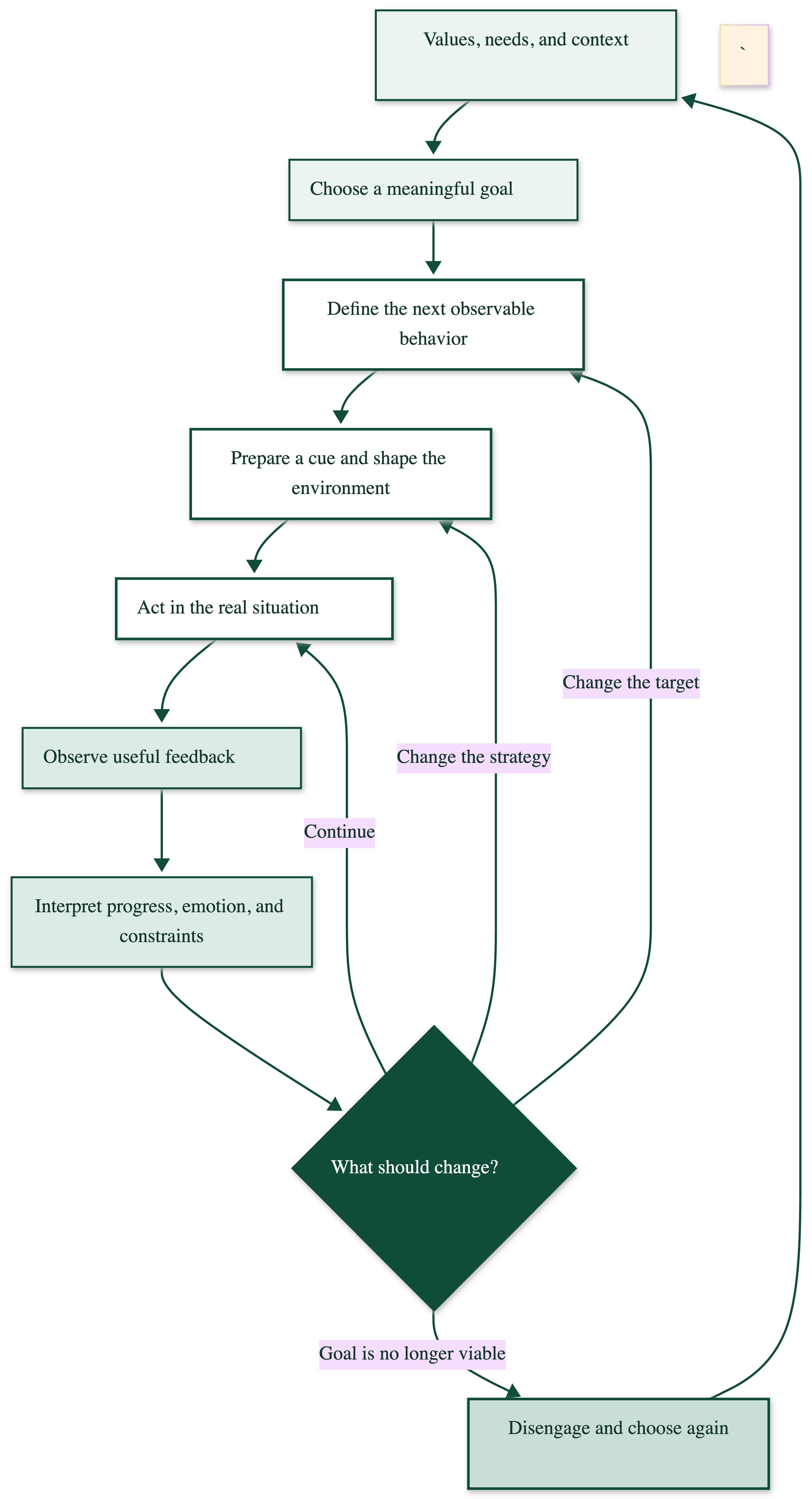
Read the diagram clockwise. A meaningful goal becomes a specific action. The action is attached to a situation and supported by the environment. Feedback then changes the next decision. The loop includes persistence, but it also includes strategy change and exit.
Most failed systems skip from “choose a goal” directly to “try harder.” The useful work sits in between.
A Goal Needs a Situation, Not Another Motivational Quote
“I want to read more” is a preference. “If I sit down with coffee on Saturday morning, I will read ten pages before opening social media” is a plan.
The second statement is an implementation intention, usually expressed as an if-then plan. It connects a recognizable situation to a prepared response. Instead of waiting for the mind to notice an abstract goal at the right time, the person decides in advance which cue should trigger which action.
Peter Gollwitzer and Paschal Sheeran's meta-analysis examined 94 independent tests and found a medium-to-large average effect on goal attainment. The plans helped people begin action, protect an ongoing goal from interruption, leave failing strategies, and preserve capacity for later effort.
The mechanism is practical. A defined cue becomes easier to notice, and the prepared response requires less deliberation. The decision has not disappeared. It has been moved to a calmer moment.
A useful if-then plan has four properties:
- The cue is observable. “When I feel ready” is not observable enough. “After I place my dinner plate in the sink” is.
- The action is small enough to begin. The first action should open the behavior, not describe the ideal final performance.
- The context is realistic. A plan that ignores travel, caregiving, illness, workload, or available space is motivational fiction.
- A recovery path exists. If the main cue is missed, the system should specify the next opportunity rather than declare the week ruined.
This is why better planning often feels less heroic. Heroism is expensive. A cue, a prepared action, and a pair of shoes beside the door are less dramatic and considerably easier to repeat.
Progress Must Inform the Next Decision
Goals require feedback. Without it, effort becomes a story the mind tells about itself.
Emotion is part of that feedback. It can reflect not only how far a person is from a goal, but whether progress feels faster or slower than expected. Frustration may therefore signal a bad strategy, an unrealistic pace, or a goal conflict rather than a defective personality.
Benjamin Harkin and colleagues analyzed 138 studies with 19,951 participants. Interventions that increased progress monitoring also improved goal attainment. Effects were stronger when progress was physically recorded or made visible to others.
That finding explains the appeal of streaks, dashboards, checklists, wearable rings, and public commitments. It does not prove that every number deserves attention.
A streak measures whether an event was recorded on consecutive days. It may not measure the quality of the behavior, its outcome, the cost of maintaining it, or whether the goal still matters. A productivity dashboard can become a beautiful instrument for optimizing the wrong life.
Useful monitoring answers one of three questions:
- Did the behavior happen?
- Did it produce the expected result?
- What should change next?
Anything else needs to justify the attention it consumes.
The same restraint applies to public accountability. Visibility can strengthen commitment. It can also turn a private goal into status performance, shame, or avoidance. The right amount of monitoring is the smallest amount that improves the next decision.
Emotion Regulation Is Not Emotional Suppression
People often treat emotion as interference arriving from outside the rational system. In reality, emotion is part of the system. It changes attention, perceived risk, memory, urgency, and the value of available choices.
James Gross's process model of emotion regulation is useful because it shows that regulation can begin long before someone tries to suppress a response. The model identifies five intervention points:
- Situation selection: choosing whether to enter a situation.
- Situation modification: changing the situation itself.
- Attentional deployment: directing or shifting attention.
- Cognitive change: changing the interpretation of what is happening.
- Response modulation: changing behavior, expression, or physiology after the emotion has developed.
This changes the practical question. Instead of asking, “How do I stop feeling this?” a person can ask, “Where in the process can I still intervene?”
Sometimes the answer is to leave the room. Sometimes it is to remove a notification, ask for clarification, reinterpret an ambiguous message, slow breathing, delay a reply, seek another person, or accept that an unpleasant feeling is appropriate to the situation.
The 2024 Handbook of Emotion Regulation adds another loop around those five intervention points. A person must first identify whether regulation is needed, select a strategy, implement it, and monitor what happens. Failure can occur at any stage. Someone may misread the emotion, choose a strategy that does not fit the situation, understand the right strategy but execute it poorly, or keep using it after the context has changed.
This is why flexibility matters more than memorizing a list of supposedly good techniques. Reappraisal, which means changing how a situation is interpreted, often helps. It is not always the right response when the situation itself can and should be changed. Suppressing visible expression can be useful in some settings, but it may leave the internal experience unchanged and can carry cognitive or social costs.
A meta-analysis of 306 experimental comparisons reaches the same broader conclusion. Labels such as distraction, reappraisal, concentration, and suppression contain different strategies with different effects. There is no universal emotional button marked “regulate.”
Emotion regulation is the ability to choose a response that fits the situation and the goal. It is not the ability to look unaffected.
Sometimes Good Self-Regulation Means Giving Up
The usual self-improvement story has only two states: persistence and failure. Real self-regulation needs a third state: disengagement.
Some goals become unattainable. Others remain technically possible but no longer justify their cost. Health changes. Information improves. Responsibilities move. A goal chosen to satisfy someone else may never become personally meaningful.
Carsten Wrosch and colleagues argue that adaptive disengagement requires withdrawing both effort and commitment. Reducing effort while remaining psychologically trapped creates distress without progress. Giving up becomes beneficial when resources can be redirected toward another meaningful goal.
This does not make quitting automatically wise. The difficult question is the break point between a demanding goal and a dead one.
A serious review should ask:
- Is the goal still possible under current constraints?
- Is the underlying value still important?
- Has the strategy failed, or has the goal failed?
- What has been learned from the attempt?
- Is there a meaningful alternative for the same value?
A language-learning goal might shrink from daily fluency practice to two focused sessions a week. A planned marathon might become regular walking during recovery. A project might be closed because the evidence changed, not because the person became weak.
Persistence protects goals. Disengagement protects the person from goals that should no longer own them.
Motivation Has Quality, Not Just Quantity
Self-Determination Theory, or SDT, explains why two people can perform the same behavior with different chances of sustaining it.
One person acts because of surveillance, reward, guilt, fear, or social pressure. Another understands and endorses the value of the action, even if the action itself is not enjoyable. Both are motivated. The quality of that motivation differs.
SDT identifies three basic psychological needs:
- Autonomy: the action feels chosen and self-endorsed.
- Competence: the person can experience effectiveness and progress.
- Relatedness: the person feels respected, understood, or connected.
Autonomy does not mean unlimited choice or absence of structure. A coach, teacher, product, or program can provide clear standards while remaining autonomy-supportive. It explains the reason, acknowledges difficulty, offers meaningful choices, and avoids turning pressure into a personality test.
The 2023 Oxford Handbook of Self-Determination Theory describes internalization, the process through which an externally prompted behavior becomes personally understood and endorsed. This is especially important for behaviors that may never become inherently fun. Paying bills, attending rehabilitation, preparing for an exam, or limiting compulsive phone use does not need to become delightful. The value needs to become one's own.
That is where digital products face an uncomfortable conflict.
Behavior-Change Apps Often Optimize the Wrong Behavior
A behavior-change product can be very good at getting people to use a behavior-change product.
That sentence sounds ridiculous until it becomes the metric dashboard.
Daily active users rise. Notifications bring people back. Streaks become longer. Badges are collected. The team celebrates retention. None of those metrics proves that the target behavior has improved outside the interface.
Lize Alberts, Ulrik Lyngs, and Kai Lukoff reviewed 15 human-computer interaction papers that applied SDT to behavior-change technologies and identified 50 design suggestions. Their central criticism is sharp: many systems use SDT to increase engagement with the technology rather than helping users internalize the value of the target behavior.
If the product succeeds, the user may eventually need fewer prompts, shorter sessions, and less external control. The healthiest retention curve may contain a decline that ordinary product analytics would classify as failure.
The wider product evidence is not especially comforting. A review of 367 digital self-control tools found that blocking and removal features dominated, while habit scaffolding and support for reflective agency were underused. A 2026 systematic review of 77 mental-health apps found average functional quality, moderate behavior-change potential, limited use of behavior-change techniques, and little randomized evidence for many products.
Polish is not proof. A feature can be theoretically plausible, beautifully animated, highly rated, and still fail to produce the intended outcome.
Engagement-first apps and capability-first systems optimize different outcomes
Engagement-first products optimize return visits, streaks, and feature use. Capability-first systems diagnose the actual regulatory bottleneck, support meaningful goals, prepare action, practice skills, adapt to context, and gradually reduce dependence on prompts.
| Product decision | Engagement-first design | Capability-first design |
|---|---|---|
| Goal selection | Accept any stated goal and begin reminders | Test meaning, feasibility, pressure, and available support |
| Diagnosis | Treat missed action as low motivation | Separate initiation, inhibition, persistence, emotion, context, and recovery failures |
| Planning | Ask for a target date | Create an observable action, cue, exception, and recovery plan |
| Notifications | Maximize return frequency | Intervene only when support is useful and the person is receptive |
| Progress | Reward logging and streak continuity | Show the smallest signal that improves the next decision |
| Personalization | Infer motivation from clicks and missed sessions | Combine transparent signals with user explanation and override |
| Failure | Reset the streak or increase pressure | Diagnose friction, revise the strategy, recover, or change the goal |
| Success | More sessions and longer retention | More independent action, better judgment, and less required support |
The difference is not cosmetic. It changes onboarding, notification logic, measurement, business incentives, and the product's definition of success.
A Better Digital Self-Regulation Product
A useful self-regulation product should behave more like temporary scaffolding than a digital supervisor.
Begin with the reason
Onboarding should ask why the goal matters, whether it feels chosen or pressured, what has already been tried, and which constraints are real. It should not diagnose character from a missed habit.
Convert intention into a viable plan
The product should help define the next observable behavior, attach it to a cue, reduce environmental friction, and create a recovery path. “Exercise more” is not ready for automation.
Diagnose the bottleneck before adding pressure
Not starting, failing to stop, and failing to continue are different problems. So are a missing cue, a strong habit, poor sleep, emotional overload, an unrealistic target, and a goal that never became personally meaningful. A useful system should locate the failed link before prescribing another reminder.
Intervene at the right moment, including not at all
Just-in-time adaptive interventions, usually shortened to JITAIs, use context to decide what support to provide and when. Inbal Nahum-Shani and colleagues define decision points, intervention options, tailoring variables, and decision rules for this purpose.
Their most important design option may be the easiest to ignore: provide nothing.
A person can be vulnerable to an unwanted behavior and still be unreceptive to a prompt. More notifications can create burden at exactly the moment the product claims to help. Silence must remain a valid output of the system.
Teach strategy selection, not one sacred technique
The product should offer a small repertoire of actions and explain when each may fit: change the situation, move attention, reinterpret, accept, solve the problem, seek support, delay a response, or recover physically. The objective is flexible selection, not ritual repetition.
Make the model inspectable
If the system decides that a user needs a prompt because of time, location, recent behavior, or wearable data, the user should be able to understand and override that logic. Personalization without inspectability easily becomes surveillance wearing therapeutic colors.
Build a graceful exit
Goals should be paused, revised, retired, or replaced without shame. Support should taper when independent capability grows. A completed intervention should feel like competence, not churn.
How to Improve Self-Regulation Without Another App
The same evidence produces a practical method that requires no subscription.
Choose one goal and write down:
- Why it matters: Is the value personally meaningful or mostly pressure?
- The next behavior: What can be observed within one week?
- The cue: When and where should the behavior begin?
- The friction: What predictable obstacle can be removed in advance?
- The state: Are sleep, stress, illness, hunger, or overload changing what is realistic today?
- The support: Can another person, routine, or environment carry part of the burden?
- The fallback: What happens if the main plan is missed?
- The feedback: Which single measure will improve the next decision?
- The review: Continue, change the strategy, reduce the target, seek support, or disengage?
Then review the system, not your moral worth.
If the behavior did not happen, find the failed link. The goal may be weak, the cue invisible, the action too large, the environment hostile, the emotional strategy wrong, or the week genuinely overloaded. Different failures require different repairs.
This approach is less satisfying than calling yourself disciplined or lazy because it refuses a single explanation. It is more useful for the same reason.
You Should Eventually Need the Product Less
Self-regulation is important. A longitudinal study following roughly 1,000 people from childhood into adulthood found that childhood self-control predicted later health, finances, substance dependence, and offending. Those associations do not prove that a habit app can produce the same life outcomes, but they show why the underlying capability deserves serious attention.
Serious attention means resisting the most marketable simplifications.
Willpower is not the whole system. Persistence is not always wisdom. Emotional silence is not regulation. App retention is not behavior change. A sensor is not a diagnosis. A streak is not a life.
The better objective is to help a person choose more clearly, prepare earlier, notice what happened, respond with the right strategy, and change direction without turning every difficulty into a verdict on identity.
The strongest self-regulation system is not the one that wins an endless fight against human nature. It is the one that learns enough about human nature to stop scheduling the same fight every evening.
Sources
Vohs, K. D., & Baumeister, R. F., editors. "Handbook of Self-Regulation: Research, Theory, and Applications" Guilford Press, Third Edition, 2016. View source
Gross, J. J.. "The Emerging Field of Emotion Regulation: An Integrative Review" Review of General Psychology, Vol. 2, Issue 3, 1998. View source
Gross, J. J., & Ford, B. Q., editors. "Handbook of Emotion Regulation" Guilford Press, Third Edition, 2024. View source
Webb, T. L., Miles, E., & Sheeran, P.. "Dealing with Feeling: A Meta-Analysis of the Effectiveness of Strategies Derived from the Process Model of Emotion Regulation" Psychological Bulletin, Vol. 138, Issue 4, 2012. View source
Gollwitzer, P. M., & Sheeran, P.. "Implementation Intentions and Goal Achievement: A Meta-Analysis of Effects and Processes" Advances in Experimental Social Psychology, Vol. 38, 2006. View source
Harkin, B., Webb, T. L., Chang, B. P. I., Prestwich, A., Conner, M., Kellar, I., Benn, Y., & Sheeran, P.. "Does Monitoring Goal Progress Promote Goal Attainment? A Meta-Analysis of the Experimental Evidence" Psychological Bulletin, Vol. 142, Issue 2, 2016. View source
Wrosch, C., Scheier, M. F., Carver, C. S., & Schulz, R.. "The Importance of Goal Disengagement in Adaptive Self-Regulation: When Giving Up Is Beneficial" Self and Identity, Vol. 2, Issue 1, 2003. View source
Moffitt, T. E., Arseneault, L., Belsky, D., Dickson, N., Hancox, R. J., Harrington, H., Houts, R., Poulton, R., Roberts, B. W., Ross, S., Sears, M. R., Thomson, W. M., & Caspi, A.. "A Gradient of Childhood Self-Control Predicts Health, Wealth, and Public Safety" Proceedings of the National Academy of Sciences, Vol. 108, Issue 7, 2011. View source
Ryan, R. M., editor. "The Oxford Handbook of Self-Determination Theory" Oxford University Press, 2023. View source
Lyngs, U., Lukoff, K., Slovak, P., Binns, R., Slack, A., Inzlicht, M., Van Kleek, M., & Shadbolt, N.. "Self-Control in Cyberspace: Applying Dual Systems Theory to a Review of Digital Self-Control Tools" CHI Conference on Human Factors in Computing Systems, 2019. View source
Nahum-Shani, I., Smith, S. N., Spring, B. J., Collins, L. M., Witkiewitz, K., Tewari, A., & Murphy, S. A.. "Just-in-Time Adaptive Interventions in Mobile Health: Key Components and Design Principles for Ongoing Health Behavior Support" Annals of Behavioral Medicine, Vol. 52, Issue 6, 2018. View source
Alberts, L., Lyngs, U., & Lukoff, K.. "Designing for Sustained Motivation: A Review of Self-Determination Theory in Behaviour Change Technologies" Interacting with Computers, Vol. 38, Issue 3, 2026, advance access published 2024. View source
Leistner, D., & Richlan, F.. "Supporting Mental Health with Apps: A Systematic Review of Potential and Quality of Implemented Behavior Change Techniques in Mobile Health Applications" European Journal of Investigation in Health, Psychology and Education, Vol. 16, Issue 1, 2026. View source